
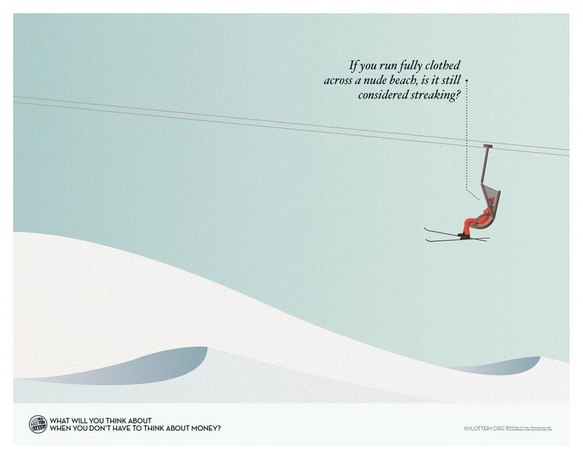
There has been a rather clever ad campaign courtesy the New York Lottery recently. I see them every time I ride the subway and they have the funny effect of not making me think about the lotto, but rather about life. It's the slogan: What will you think about when you don't have to think about money?
I guess I've been thinking a lot about money recently because I left my job in August after three years. It was a really great job with amazing benefits and incredible people. But I had gotten to the point where I couldn't get out of bed in the morning, and more importantly, I was no longer producing artistically. I was consumed with how much I hated my days. My depression blocked my focus and inspiration. So I left.
Now I'm artistically blocked because I haven't yet found a steady job and my thoughts are consumed by lack of money. I was speaking to a writer friend about this very same thing a few weeks back. We were pondering the amount of effort we expend on just trying to make ends meet and the potential of that effort put towards a better purpose. In a creative city whose constantly increasing cost makes it difficult for creatives to survive, we've been seeing a lot of friends bite the dust and move back home, wherever that is. Or enroll in law school. Or become a stay-at-home parent. Or finally take over that family business. And I wake up every day and continue to fight the good fight with no promise that I will make it another day.
Maybe this has always been New York's story: every day hundreds of people arrive to pursue their dreams and there's only so much room. But what if it's a national epidemic? What if artists are biting the dust in Seattle, and L.A., and Miami? What if life is getting so expensive and the middle class is disappearing so quickly, that the United States is basically losing its artists?
I know some people might think, But you just said hundreds arrive in New York everyday! The thing is, though, that those are usually younger people, brand new to the city, brand new to their art form. You know how you get better at practicing medicine the longer you're a doctor? Yeah, well, same goes for practicing your art. What I see happening is that we're potentially losing our artists when they're just hitting their stride. You struggle in a studio with a crazy roommate for a few years living off ramen and occasionally sleeping in the bathtub. You go to coffee shops and absorb the scene and get a pulse on what's going on while you continue to take classes and practice. And after several years of this, you get tired - the rent has gone up steadily, but your wages haven't. You remember when soap used to cost a couple of dollars less...just last year. And you've finally come up with the idea that's going to be your break, that truly conveys the human spirit: an idea for that novel/landscape/film script. But then you lose your lease, your bartending shifts get cut down, you have unpaid doctor's bills because of that bad back from sleeping in the bathtub and you have no idea how you're going to get to the next day. All that energy and passion that you had for that great creative work...that you didn't have when your intestinal tract wasn't yet eroded by too much ramen...is now spent trying to survive.
That's our art these days: survival. What message could Rent have conveyed if they'd actually been able to pay the rent? Would Jonathan Larson have encouraged us instead to feed the hungry and be kind to one another if there was room in his brain, if he weren't consumed with making ends meet? Food for thought: An interesting article about the effect on compromised brain activity when in a state of poverty. It's not just artists that bite the dust.
And I'm certainly not the only person using precious brain activity to think about what could be were it not for worries and obligations. A Tokyo artist and psychologist, Naho Iguchi, is spending a year in Berlin to experiment with making decisions not tied to worries about money or social obligations. In order to do so, she had to get funding from 22 different donors.
The haunting question remains every time I ride the subway: What would I be capable of producing if money weren't on my mind constantly? I have every intention of finding out. But others may not be so lucky.
I guess I've been thinking a lot about money recently because I left my job in August after three years. It was a really great job with amazing benefits and incredible people. But I had gotten to the point where I couldn't get out of bed in the morning, and more importantly, I was no longer producing artistically. I was consumed with how much I hated my days. My depression blocked my focus and inspiration. So I left.
Now I'm artistically blocked because I haven't yet found a steady job and my thoughts are consumed by lack of money. I was speaking to a writer friend about this very same thing a few weeks back. We were pondering the amount of effort we expend on just trying to make ends meet and the potential of that effort put towards a better purpose. In a creative city whose constantly increasing cost makes it difficult for creatives to survive, we've been seeing a lot of friends bite the dust and move back home, wherever that is. Or enroll in law school. Or become a stay-at-home parent. Or finally take over that family business. And I wake up every day and continue to fight the good fight with no promise that I will make it another day.
Maybe this has always been New York's story: every day hundreds of people arrive to pursue their dreams and there's only so much room. But what if it's a national epidemic? What if artists are biting the dust in Seattle, and L.A., and Miami? What if life is getting so expensive and the middle class is disappearing so quickly, that the United States is basically losing its artists?
I know some people might think, But you just said hundreds arrive in New York everyday! The thing is, though, that those are usually younger people, brand new to the city, brand new to their art form. You know how you get better at practicing medicine the longer you're a doctor? Yeah, well, same goes for practicing your art. What I see happening is that we're potentially losing our artists when they're just hitting their stride. You struggle in a studio with a crazy roommate for a few years living off ramen and occasionally sleeping in the bathtub. You go to coffee shops and absorb the scene and get a pulse on what's going on while you continue to take classes and practice. And after several years of this, you get tired - the rent has gone up steadily, but your wages haven't. You remember when soap used to cost a couple of dollars less...just last year. And you've finally come up with the idea that's going to be your break, that truly conveys the human spirit: an idea for that novel/landscape/film script. But then you lose your lease, your bartending shifts get cut down, you have unpaid doctor's bills because of that bad back from sleeping in the bathtub and you have no idea how you're going to get to the next day. All that energy and passion that you had for that great creative work...that you didn't have when your intestinal tract wasn't yet eroded by too much ramen...is now spent trying to survive.
That's our art these days: survival. What message could Rent have conveyed if they'd actually been able to pay the rent? Would Jonathan Larson have encouraged us instead to feed the hungry and be kind to one another if there was room in his brain, if he weren't consumed with making ends meet? Food for thought: An interesting article about the effect on compromised brain activity when in a state of poverty. It's not just artists that bite the dust.
And I'm certainly not the only person using precious brain activity to think about what could be were it not for worries and obligations. A Tokyo artist and psychologist, Naho Iguchi, is spending a year in Berlin to experiment with making decisions not tied to worries about money or social obligations. In order to do so, she had to get funding from 22 different donors.
The haunting question remains every time I ride the subway: What would I be capable of producing if money weren't on my mind constantly? I have every intention of finding out. But others may not be so lucky.
 RSS Feed
